Restoration of brain dystrophin with neuronal targeted AAV Microdystrophin or Dp140 in mdx52 mice of Duchenne muscular dystrophy
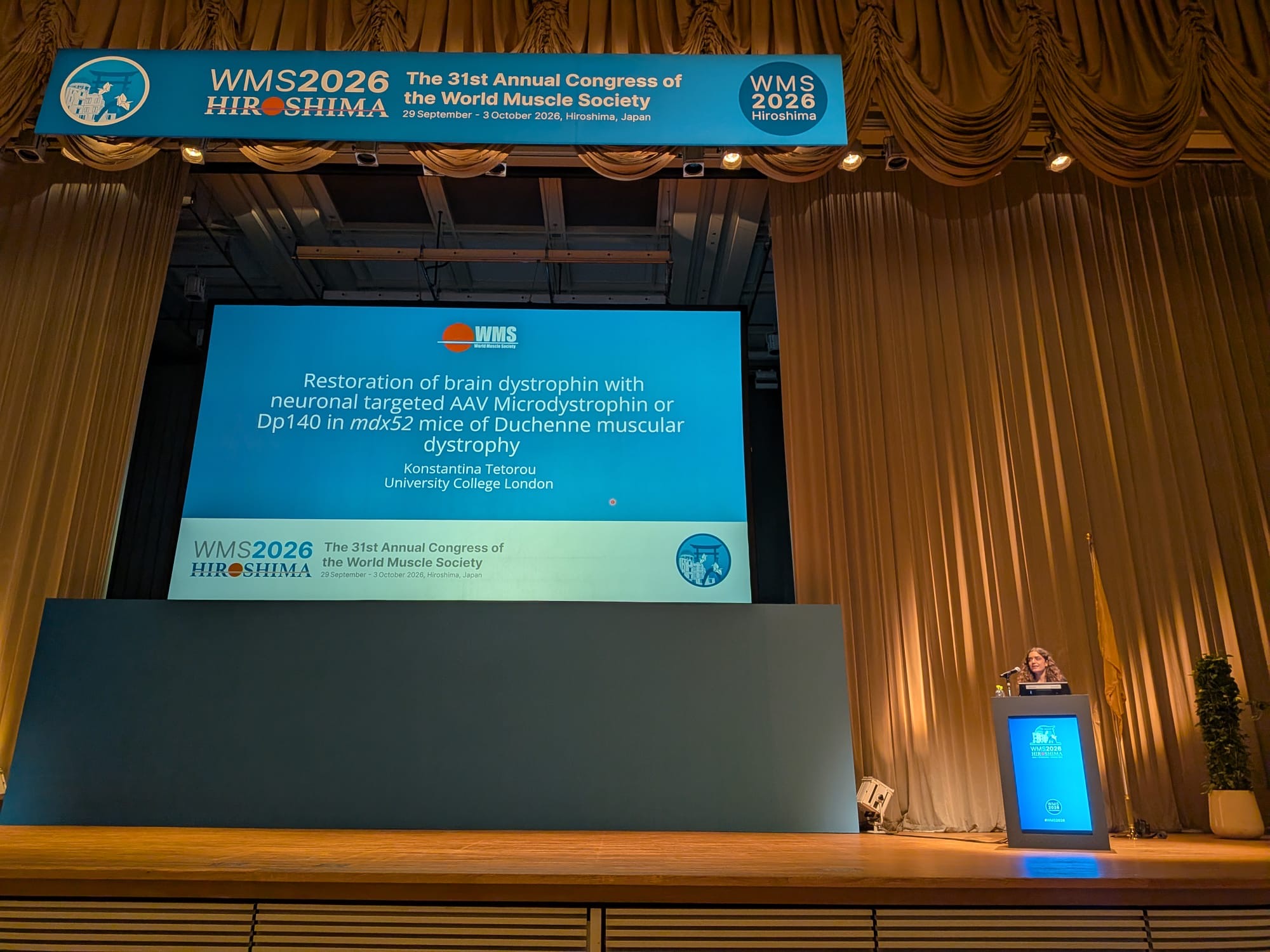
Dr Konstantina Tetorou presented at the World Muscle Society (WMS) Congress in Hiroshima, Japan. Researchers investigated whether restoring dystrophin expression using different treatment strategies in the brain could improve behavioural and motor difficulties in a mouse model of Duchenne muscular dystrophy that lacks both the full-length dystrophin protein (Dp427) and the shorter brain-associated isoform Dp140. The study compared different treatment timings, delivery routes, and dystrophin replacement strategies.
Lay Summary
Duchenne muscular dystrophy (DMD) is often thought of as a muscle disease, but many DMD individuals experience brain-related challenges as learning, behaviour, anxiety, and emotional regulation. DMD reduces the production of key dystrophin proteins in muscle and the brain, contributing to the condition’s physical, cognitive and behavioural symptoms. Scientists are therefore exploring whether gene therapies can improve brain function as well as muscle health.
In this study, researchers tested two approaches to restore dystrophin in the brains of a DMD mouse model that lacks both two important dystrophin forms and shows more severe neurological symptoms. The researchers explored treatment at different ages and using different delivery methods. These included replacing a shorter form of dystrophin, called micro-dystrophin, and a brain-associated form called Dp140..
Both neonatal (newborn) and juvenile treatment directly into the brain of micro-dystrophin treatment led to long-lasting dystrophin expression in several important brain regions and improved some anxiety-related behaviours, but did not improve muscle strength.
The greatest overall benefit was seen with delivery through the bloodstream of micro-dystrophin treatment delivered shortly after birth. This approach not only improved anxiety-related behaviours but also improved grip strength, walking ability, balance, and coordination. Dp140 replacement restored dystrophin widely throughout the brain and improved some behavioural measures, but did not improve muscle strength.
These findings highlight that treatments targeting brain dystrophin may help improve some neurological and behavioural features of DMD. They also suggest that when treatment is given, how it is delivered, and which dystrophin isoform is restored are all important factors in determining therapeutic benefit.
Scientific Summary
Mutations in the DMD gene disrupt expression of multiple dystrophin isoforms in both skeletal muscle and the central nervous system, contributing to cognitive, behavioural, and neuromuscular manifestations. The mdx52 mouse model lacks Dp427 and Dp140 expression and exhibits a more severe neurological phenotype than models deficient only in Dp427.
This study evaluated the therapeutic effects of neuronal-targeted AAV9.hSyn.µDys delivery at different ages and administration routes, alongside neonatal systemic replacement of the Dp140 isoform. Juvenile mdx52 mice received intracerebroventricular (ICV) AAV9.hSyn.µDys at four weeks of age and were compared with previous neonatal ICV-treated cohorts. Separate cohorts received neonatal systemic AAV9.hSyn.Dp140 administration shortly after birth and were compared with untreated mdx52 controls, wild-type mice, and previously studied neonatal systemic µDys-treated animals.
Both neonatal and juvenile ICV µDys delivery resulted in sustained dystrophin expression in the cortex, hippocampus, and midbrain, with improvements in selected anxiety-related behavioural outcomes. However, neither intervention improved grip strength.
In contrast, neonatal systemic µDys delivery restored expression at the neuromuscular junction, corrected electrophysiological abnormalities, and significantly improved grip strength, gait performance, beam-walking ability, and anxiety-related behaviours.
Neonatal systemic Dp140 treatment achieved widespread restoration throughout multiple brain regions and produced higher levels of brain expression than systemic µDys. Despite this extensive CNS restoration, benefits were restricted to partial improvements in anxiety-related behaviours, with no measurable improvement in grip strength.
Overall, the findings demonstrate that dystrophin restoration in the CNS can improve behavioural outcomes in DMD, but effective motor rescue depends on treatment timing, route of administration, and the specific dystrophin isoform being replaced. These data support continued development of brain-targeted therapeutic approaches alongside strategies that address both central and peripheral disease manifestations.
Take home messages
- Brain dystrophin restoration improves behaviour: Both micro-dystrophin and Dp140 replacement improved selected anxiety-related behaviours in mdx52 mice.
- Timing matters: Therapeutic benefit was observed following both neonatal and juvenile treatment in the brain, demonstrating that dystrophin replacement is retained beyond the neonatal period.
- Delivery route is critical: Brain-only (ICV) treatment improved behavioural outcomes but did not enhance muscle strength.
- Systemic micro-dystrophin produced the broadest benefits: Neonatal systemic µDys improved neuromuscular junction function, grip strength, gait, balance, and anxiety-related behaviours.
- Dp140 showed strong brain restoration: Systemic Dp140 delivery achieved widespread expression throughout the brain and improved behavioural measures, highlighting the potential importance of brain-specific dystrophin isoforms.
- Future CNS therapies may need tailored approaches: Optimal outcomes are likely to depend on the dystrophin isoform targeted, the timing of intervention, and the cellular and tissue specificity of gene delivery.
Reference